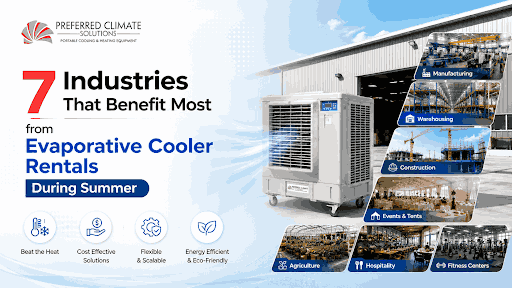
Every summer, the same problem shows up across businesses of all kinds: indoor and outdoor spaces get hot faster than facilities can handle. Production slows, employees struggle to stay comfortable, equipment runs at reduced efficiency, and in some industries, the heat creates real safety and compliance risks. Permanent HVAC systems aren’t always built to handle seasonal extremes, and installing new infrastructure just to get through a few months of high temperatures rarely makes financial sense.
This is where evaporative cooler rentals come in. Rather than committing to a full-scale cooling system, businesses can bring in temporary, high-performance equipment exactly when and where it’s needed, then scale it back once the heat breaks.
Often referred to as swamp coolers, these units work differently than standard air conditioners. Instead of using refrigerant to cool recirculated air, they pull hot, dry air through water-saturated pads. As the water evaporates, it absorbs heat from the air, and the cooled air is pushed back into the space. This works especially well in large, open, or well-ventilated areas, which makes it a strong fit for warehouses, construction sites, garages, and outdoor venues where traditional AC would struggle or cost significantly more to operate.
A portable cooling rental also solves a logistics problem many businesses don’t think about until they’re in the middle of a heat wave: speed. Rental providers can typically deliver and set up equipment same-day, which matters when temperatures spike unexpectedly or a project timeline shifts. Below is a closer look at seven industries where this kind of rental solution makes a measurable difference.
1. Construction
Construction sites are among the most physically demanding environments to work in during summer. Crews are frequently exposed to direct sun, working inside partially enclosed structures, or laboring near equipment that generates additional heat. Heat-related illness is a genuine safety concern on job sites, and OSHA has increasingly focused enforcement attention on heat exposure in outdoor and industrial work environments.
An evaporative cooler rental can be positioned at break areas, inside tents, trailers, or partially built structures to give crews a place to recover during the workday. Beyond worker comfort, temperature control also plays a role in certain construction processes. Concrete curing, for example, is sensitive to temperature and humidity, and materials like adhesives and coatings can perform inconsistently in extreme heat.
Because construction projects move through phases, and job sites change from week to week, owning cooling equipment rarely makes sense. A site might need intensive cooling during framing and finishing, then far less once a structure is enclosed. Renting allows construction companies to bring in exactly the capacity they need for each phase, then return the equipment once it’s no longer required, rather than storing and maintaining machinery that sits idle most of the year.
2. Warehousing and Distribution
Warehouses present a unique cooling challenge. High ceilings, large open floor plans, and constant activity at loading docks make these spaces difficult and expensive to cool using traditional ducted air conditioning. Many warehouses were also built without climate control in mind, which leaves facility managers scrambling when summer temperatures climb and inventory, equipment, or staff comfort is at risk.
Evaporative cooling rentals are particularly well suited to this environment because they’re designed to move large volumes of air efficiently, without the heavy energy draw associated with conventional AC systems. Units can be placed strategically near loading docks, pick zones, packing stations, or break areas, targeting cooling where employees spend the most time rather than trying to cool an entire facility evenly.
This matters for two reasons: employee safety and product protection. Workers moving heavy inventory in high heat are at elevated risk of fatigue and heat-related illness, which can slow operations and increase the chance of accidents. At the same time, temperature-sensitive inventory can degrade if storage conditions aren’t maintained. A portable cooling rental gives warehouse operators a way to address both concerns quickly, without retrofitting the building or investing in permanent climate control for a problem that’s mostly seasonal.
3. Manufacturing
Manufacturing facilities deal with a compounding heat problem. Production machinery, presses, ovens, and motors all generate their own thermal load, and that heat builds on top of whatever the outdoor temperature is already contributing. In facilities running multiple shifts through summer, indoor temperatures can climb well past safe or comfortable levels, especially in older buildings without modern climate control infrastructure.
This creates risk on two fronts. First, employee safety becomes a concern as heat exposure builds over long shifts, particularly near equipment that adds to ambient temperature. Second, some manufacturing processes are sensitive to temperature fluctuations, meaning uncontrolled heat can affect product consistency or material behavior.
A swamp cooler rental can be deployed directly at hot zones on the production floor, near specific machinery, or in high-traffic work areas where staff spend extended periods. Because production needs shift based on order volume or seasonal demand, the ability to reposition rental units, or scale up with additional ones during a hot stretch, gives manufacturers more control than a fixed, built-in system would allow, without paying to run or maintain cooling capacity needed for only part of the year.
4. Event Planning and Hospitality
Outdoor weddings, festivals, corporate gatherings, and trade shows all share one thing in common: guest comfort directly affects how the event is remembered. A beautifully planned outdoor event can be undermined quickly if attendees are uncomfortably hot, and that risk only grows during peak summer months.
Evaporative cooler rentals have become a go-to solution for event planners because they cool large, open, or tented spaces quickly and don’t require the kind of installation traditional air conditioning demands. They also tend to be quieter and easier to integrate into a temporary setup than retrofitting ductwork into a tent or outdoor pavilion.
There’s also a practical cost argument here. Most event venues don’t need cooling equipment on a permanent basis. A portable cooling rental lets event planners bring in exactly the capacity needed for a single event, whether that’s one large unit for a tent or several units spread across an outdoor venue, and then have it removed once the event concludes. There’s no equipment to store or maintain between bookings, which keeps costs predictable.
You can also read about Maximizing Energy Efficiency with the Right Water Heater.
5. Automotive Shops and Dealerships
Service bays, detail areas, and dealership lots are some of the most heat-exposed commercial spaces around. Garage doors are frequently open, bays often lack central air conditioning by design, and technicians working under hoods or beneath vehicles deal with both ambient heat and the heat radiating off the vehicles themselves.
This creates a comfort and safety issue for staff, but it also affects customer experience. Dealerships in particular rely on customers being willing to spend time browsing a lot or sitting in a waiting area, and summer heat can shorten visits or push potential buyers toward air-conditioned competitors.
A portable cooling rental offers a flexible way to address both problems without major construction. Units can be placed directly in service bays to keep technicians cooler while they work, or positioned near customer-facing areas like waiting rooms, outdoor display lots, or sales tents during promotional events. Because automotive businesses often see seasonal spikes in service demand as vehicles struggle more in extreme heat, rental cooling can scale up during the busiest months and scale back the rest of the year.
6. Film and Photography Production
Film and photography sets present a cooling challenge that’s different from most other industries: comfort matters, but so does noise. Studio lighting setups generate significant heat, sometimes turning an enclosed set uncomfortably warm within minutes, and outdoor shoots expose cast and crew to direct summer heat for hours at a stretch.
Standard air conditioning units can be too loud for sets where audio is being recorded live, which makes evaporative cooling a more practical choice in many production environments. These units run quieter, allowing crews to keep cast and staff comfortable without constantly pausing for sound issues.
Productions are also, almost by definition, temporary. A shoot might run for a single day or stretch across several weeks at a specific location, but it’s rarely a permanent setup. That short-term, location-dependent nature lines up naturally with a rental model rather than a fixed cooling system, letting production teams bring in the right amount of cooling capacity for the specific set, soundstage, or location they’re working with at the time.
7. Healthcare and Medical Facilities
Healthcare facilities operate under a different kind of pressure when it comes to temperature control. Hospitals, labs, pharmacies, and medical storage areas often have strict requirements, not just for patient and staff comfort, but for regulatory compliance and the integrity of sensitive medical supplies, including medications and lab samples that can degrade outside specific temperature ranges.
When a primary HVAC system fails, or a facility needs supplemental cooling during an extreme heat event, there’s very little room for delay. Unlike many other industries, healthcare facilities generally can’t simply wait out a hot week or push through with reduced comfort. Equipment and supply integrity, along with patient safety, depend on stable conditions being maintained continuously.
Rental cooling equipment offers a fast way to bridge that gap. Units can be deployed as a backup system while a primary HVAC unit is repaired, or as supplemental cooling during periods of unusually high demand, helping facilities maintain the consistent environment that healthcare operations require until normal conditions are restored.
Why Renting Makes More Financial and Operational Sense
Across all seven of these industries, a clear pattern emerges. Cooling demand tends to be seasonal, project-based, or unpredictable, which makes owning dedicated equipment a questionable investment for most businesses. Evaporative cooler rentals address that mismatch directly, and the advantages fall into a few key areas:
Lower upfront cost. Purchasing industrial cooling equipment outright requires significant capital, plus ongoing maintenance and storage costs for months when it isn’t in use. Renting converts that fixed cost into a flexible operating expense tied directly to actual need.
Faster response to unexpected heat. Heat waves don’t always follow a predictable schedule, and neither do equipment failures or sudden spikes in demand. A rental provider with same-day delivery can get cooling capacity on-site quickly, which matters far more than waiting weeks for new equipment to be ordered and installed.
Scalability. Businesses can rent additional units during the hottest stretches of summer, then scale back once conditions normalize. That flexibility is difficult to replicate with owned equipment, which is either sized for peak demand and underused most of the year, or undersized and unable to keep up when it’s needed most.
Reduced maintenance burden. Rental providers typically handle servicing, repairs, and upkeep as part of the agreement, removing that responsibility from the renting business entirely.
Equipment matched to the space. A reputable rental provider sizes equipment based on the specific square footage, airflow, and heat load of a space, rather than relying on a generic unit that’s either underpowered for the job or far more than what’s actually needed.
Final Thoughts
No matter which industry a business operates in, summer heat has a way of revealing gaps in cooling capacity right when it matters most. Whether it’s a construction crew working through a heat advisory, a warehouse protecting both inventory and staff, or a hospital that can’t afford a lapse in temperature control, the underlying challenge is the same: heat creates risk, and that risk needs to be managed quickly.
Evaporative cooler rentals offer a practical way to close that gap without the cost or long-term commitment of permanent systems. They deliver targeted, efficient cooling exactly where and when it’s needed, and they scale with the season rather than sitting idle the rest of the year.
If you’re searching for a dependable swamp cooler rental this season, Preferred Climate Solutions offers same-day delivery, properly sized equipment, and 24/7 emergency support across Texas and Oklahoma. With more than 17 years of experience serving construction, warehousing, healthcare, manufacturing, automotive, and event clients, they’re built to keep operations running no matter how high the temperature climbs.