Imagine a small boutique consultancy in Dubai. In their first year, they were so focused on landing clients and delivering projects that they ignored a “minor” administrative detail: their VAT filing. Since they had no taxable sales in the first three months, the founder assumed they didn’t need to do anything. “No revenue, no tax, no problem,” they thought.
Six months later, they logged into the EmaraTax portal to find a devastating reality. They were hit with a string of compounding fines for non-filing and late registration. The total? Over AED 30,000. What was a thriving startup suddenly faced a cash-flow crisis, not because of a bad product, but because of a misunderstanding of the law.
In the UAE, the Federal Tax Authority (FTA) is efficient, digital-first, and most importantly unforgiving when it comes to deadlines. Penalties are fast, they are compounding, and they are designed to enforce a culture of strict compliance. This guide is your roadmap to understanding how these penalties work, how to calculate them, and, most importantly, how a robust system of vat tax accounting can ensure you never pay a single dirham in fines.
What Are VAT Penalties in the UAE?
VAT penalties are administrative fines imposed by the FTA on taxable persons (businesses or individuals) who fail to comply with the requirements of the UAE VAT Law.
The FTA doesn’t view these fines as a revenue stream, but as a regulatory tool. The goal is to ensure that every “Taxable Person” maintains transparent records and contributes to the national economy on time. Whether it’s a simple clerical error or a major delay in registration, the system is automated. Once a deadline passes, the penalty is often triggered instantly by the EmaraTax system.
Complete List of UAE VAT Penalties
To stay safe, you must know what you are up against. Below is a breakdown of the most common administrative penalties businesses face today.
Common Administrative Penalties Table
| Violation Type | Initial Penalty Amount |
| Late VAT Registration | AED 10,000 |
| Late VAT Deregistration | AED 10,000 |
| Late Filing of VAT Return | AED 1,000 (first time); AED 2,000 (repetition within 24 months) |
| Late Payment of Tax | 2% immediately; compounding monthly (see below) |
| Incorrect Tax Return | Fixed fine + percentage of the tax difference |
| Failure to Maintain Records | AED 10,000 (first time); AED 50,000 (repetition) |
| Failure to Issue Tax Invoice | AED 2,500 per instance |
How VAT Penalties Are Calculated?
The most confusing aspect of the UAE tax system for many is the late payment penalty. Unlike the fixed fee for late filing (AED 1,000), late payment is a moving target that can grow to three times the original tax amount.
The Compounding Structure
If you owe VAT and fail to pay it by the deadline, the penalty follows this specific timeline:
- 2% of the unpaid tax is applied immediately on the day following the due date.
- A 4% monthly penalty is applied on the same day of the month following the due date, and every month thereafter, on the unsettled tax amount.
A Step-by-Step Calculation Example
Let’s say your company owes AED 10,000 in VAT. The deadline was March 28th, but you didn’t pay until May.
- March 29 (Day 1): An immediate penalty of 2% is triggered.
$$10,000 \times 0.02 = 200 \text{ AED}$$ - April 29 (Month 1): A 4% monthly penalty is added.
$$10,000 \times 0.04 = 400 \text{ AED}$$ - May 29 (Month 2): Another 4% is added.
$$10,000 \times 0.04 = 400 \text{ AED}$$
By late May, your AED 10,000 debt has grown by AED 1,000 in penalties alone. While the law previously had a daily 1% charge, the current structure focuses on these monthly increments, capped at 300% of the original tax amount.
Real-Life Scenarios: Where It All Goes Wrong?
Case Study 1: The No Revenue Trap
An e-commerce startup registered for VAT but had zero sales for two quarters. They assumed that because there was no tax to pay, they didn’t need to file.
- The Result: Two missed filings (AED 1,000 + AED 2,000) plus administrative fines. The FTA issued a total penalty of AED 13,000.
- The Lesson: Even a “Nil” return must be filed on time.
Case Study 2: The Late Registration
A consultancy crossed the AED 375,000 mandatory threshold in January but didn’t apply for a TRN until June.
- The Result: An automatic AED 10,000 fine for late registration, plus the FTA required them to pay VAT on all sales made since January out of their own pocket, since they hadn’t charged their clients yet.
- The Lesson: Monitor your rolling 12-month turnover monthly.
Top Mistakes That Trigger VAT Penalties
Most penalties are not caused by bad intent, but by poor vat tax accounting habits.
- Missing the 28-Day Window: VAT returns and payments are usually due by the 28th day of the month following the end of your tax period.
- Registering Incorrectly: Inputting the wrong financial year end or business activity during registration can lead to rejected filings later.
- Manual Calculation Errors: Using Excel sheets to track VAT is a recipe for disaster. One broken formula can lead to an “Incorrect Return” penalty.
- Ignoring FTA Notifications: The EmaraTax portal sends alerts. If your registered email is an unmonitored “info@” address, you will miss critical warnings.
VAT Myths & Misconceptions
- Myth: “I’m in a Free Zone, so VAT doesn’t apply to me.”
- Reality: Most Free Zone companies are subject to VAT if they trade within the UAE or provide services locally.
- Myth: “Small businesses get a grace period.”
- Reality: There is no grace period. The day you cross the threshold, the clock starts.
- Myth: “You can just call the FTA and explain, and they will waive it.”
- Reality: While a “Reconsideration” process exists, it is strictly evidence-based. “I forgot” is not a valid reason for a waiver.
You can also read about Is More Funding Always Better?
What To Do If You Already Have VAT Penalties?
If you log in and see a red balance, do not panic, but do act immediately.
- Identify the Source: Is it for late filing, late payment, or an error?
- File Pending Returns: You cannot fix a penalty for a return that hasn’t been submitted yet.
- Pay the Original VAT: Clear the tax debt first to stop the compounding 4% monthly penalties.
- Submit a Voluntary Disclosure (VD): If you found an error in an old return, a VD is the official way to correct it before the FTA finds it. This often results in lower penalties than an audit-led discovery.
- Apply for Reconsideration: You have 40 business days from the date of the penalty to submit a reconsideration request if you have a legitimate legal or technical reason.
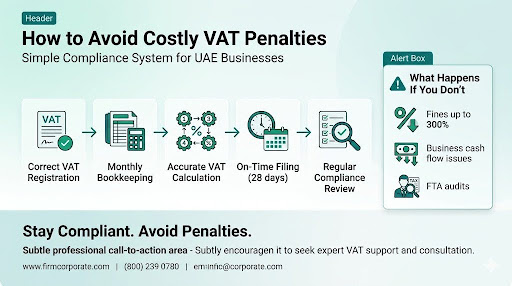
How to Avoid VAT Penalties: A System-Based Approach?
The only way to stay safe is to move away from “reminder notes” and toward a professional vat tax accounting system.
The Compliance Checklist
- Monthly Reconciliation: Match your bank statements to your invoices every 30 days.
- Automated Reminders: Set your filing deadline for the 20th of the month, not the 28th.
- Accurate Invoicing: Ensure every invoice has your TRN and meets FTA requirements.
- Professional Oversight: Have a tax expert review your return before you hit “Submit.”
VAT Tax Accounting Best Practices
Proper vat tax accounting is the backbone of a healthy business. It isn’t just about bookkeeping; it’s about tax-proofing your ledgers.
- Input vs. Output Tracking: You must clearly segregate the VAT you collect (Output) from the VAT you pay (Input). You can only claim Input VAT if you have a valid Tax Invoice from a registered supplier.
- Record-Keeping: The law requires you to keep records for 5 years (15 years for real estate). This includes invoices, credit notes, and customs documents.
- Software Integration: Use FTA-approved accounting software that automatically generates a VAT Audit File (FAF). This makes responding to FTA queries a matter of minutes, not days.
FTA Audits & Red Flags
An audit is a formal examination of your business records by the FTA. They don’t pick businesses at random; they look for red flags:
- Consistent “Nil” Returns: If you are active but never report sales, it triggers an alert.
- Frequent Voluntary Disclosures: Constantly “correcting” your past returns suggests a lack of proper accounting systems.
- Unusual Refund Requests: Large VAT refund claims will almost always trigger a pre-refund audit.
Latest UAE VAT Updates (2025–2026)
As we move through 2026, the FTA has introduced more sophisticated AI-driven monitoring. There is a greater push toward e-invoicing, which will eventually link your invoicing system directly to the FTA. This means errors will be caught in real-time. Staying ahead of these trends requires a proactive advisor who understands the shift toward “Real-Time Compliance.”
When Should You Hire a VAT Expert?
You don’t need a full-time tax director, but you do need professional oversight if:
- Your monthly revenue is fluctuating significantly.
- You are involved in imports and exports (Zero-rated vs. Exempt).
- You have received a penalty notice and don’t know why.
- Your current “accountant” is just a data-entry clerk who doesn’t understand UAE tax law.
How Dubai Business and Tax Advisors Helps?
VAT is a distraction from your core mission. At Dubai Business and Tax Advisors, we turn compliance from a burden into a seamless background process.
- Penalty Reduction: We analyze your fines and manage the entire Reconsideration process with the FTA.
- Filing & Management: We handle your vat tax accounting and filing, ensuring 100% accuracy and zero late fees.
- Audit Support: If the FTA calls, we stand between you and the auditor, providing the necessary documentation and legal arguments.
- Registration Support: We ensure your business is structured correctly from day one.
Frequently Asked Questions
What are the most common VAT penalties businesses face in the UAE?
Late VAT return filing incurs AED 1,000 for the first offense, AED 2,000 for repeat violations within 24 months. Late payment of VAT owed triggers penalties starting at AED 2,000 or 2% of unpaid tax (whichever is higher), increasing daily. Failure to register for VAT when required costs AED 10,000, and non-maintenance of proper records can result in AED 10,000 penalties. All penalties are applied automatically by the FTA system.
Can I appeal or reduce FTA penalties if I have a valid reason for non-compliance?
Yes. The FTA allows penalty appeals within 20 business days of the penalty notice if you have legitimate reasons like technical errors, natural disasters, or serious illness. You must submit a formal reconsideration request through the FTA portal with supporting evidence. Voluntary disclosure of errors before an FTA audit also significantly reduces penalties sometimes down to zero for genuine mistakes with no intent to evade tax.
What happens if I file my VAT return late but pay the tax on time?
You’ll still face the late filing penalty of AED 1,000 minimum, even if you’ve paid all tax owed correctly and on time. Filing and payment are separate compliance requirements with separate penalties. The FTA system automatically generates penalties once deadlines pass, so even being one day late triggers the fine. Setting calendar reminders well before the 28-day deadline is essential to avoid this.
How does the FTA detect non-compliance and trigger penalties?
The FTA uses automated systems that monitor filing deadlines, cross-reference transaction data, and flag discrepancies between VAT returns and customs declarations or supplier invoices. They also conduct random and risk-based audits targeting specific sectors or businesses with unusual patterns. Non-compliance triggers automatic penalties immediately, and serious violations can lead to full tax audits, additional assessments, and criminal prosecution for deliberate evasion.
What’s the best way to avoid VAT penalties altogether?
Implement robust accounting systems using FTA-approved software, set automated reminders for filing and payment deadlines, and reconcile your VAT accounts monthly instead of waiting until quarter-end. Engage a professional tax advisor or accountant to review returns before submission and ensure compliance with all FTA regulations. Proactive compliance management costs far less than penalties, interest, and audit stress from getting it wrong.
Conclusion
VAT penalties in the UAE are not a suggestion; they are a mathematical certainty for those who ignore the rules. Most businesses that fall into the “penalty trap” do so because they lacked a professional VAT tax accounting system or assumed the FTA would be lenient.
The reality of 2026 is that compliance is digital and instantaneous. The good news? These penalties are 100% avoidable. With the right systems, clear records, and expert advice from Dubai Business and Tax Advisors, you can ensure that your hard-earned profits stay in your business, not in a penalty fund.
Ready to protect your business from costly FTA fines? Contact Dubai Business and Tax Advisors today for a comprehensive VAT Health Check on your current accounting records. We’ll identify potential penalty risks before your next filing deadline and implement systems to keep you compliant and penalty-free.
Don’t wait for an FTA penalty notice to get expert support from Dubai Business and Tax Advisors now.