
Your bank account is lying to you. Or, at the very least, it isn’t telling the whole story. You just finished a record-breaking quarter, your sales team is ringing the bell daily, and your LinkedIn feed is a curated gallery of “wins.” Yet, when you look at the actual cash available for payroll or the next inventory buy, the math doesn’t feel like a victory. You’re working harder than ever, but the financial clarity you expected to arrive with scale has been replaced by a foggy, low-level anxiety. This specific brand of “successful” chaos is usually the first indicator that your company has outgrown its current financial structure. When the distance between your top-line revenue and your actual liquidity starts to widen, looking into outsourced CFO services becomes less of a luxury and more of a survival mechanism for your next stage of growth.
Many founders treat financial leadership like a “Level 20” boss they’ll deal with once they hit a certain revenue milestone. The reality is far more subtle. You don’t wake up one day and suddenly need a Chief Financial Officer; instead, you slowly realize that your accountant is looking in the rearview mirror while you are trying to drive 100 mph toward a horizon you can’t quite see. Many businesses do not realize they need strategic financial leadership until operational pressure starts affecting growth, turning what should be an exciting expansion into a relentless cycle of reactive firefighting.
Growth Is Increasing,But Financial Pressure Is Increasing Faster
Growth is expensive. It is a fundamental truth of business that often catches ambitious founders off guard. You land a massive contract, which is cause for celebration until you realize you need to hire three new account managers, upgrade your software stack, and wait sixty days for the client to cut the first check. Suddenly, that “win” has created a six-figure hole in your working capital.
This is where the hidden costs of scaling begin to erode your peace of mind. As you expand, your payroll obligations rise every two weeks regardless of when your customers decide to pay. If your margins aren’t razor-sharp, you might find that you are actually losing more money with every new sale, a phenomenon known as “overtrading.” Without a strategic eye on these shifting variables, operational complexity increases silently in the background. You see the sales climbing, but the financial strain during growth feels like a weight you can’t shake. Profits look unclear on paper, and expenses seem to sprout like weeds, leaving you wondering why growth feels so stressful instead of exciting.
You’re Making Important Decisions Without Financial Visibility
Think back to the last time you approved a major expenditure. Was it based on a real-time dashboard showing your projected cash position for the next six months? Or was it a “gut feel” decision based on the fact that the current balance looked “okay”?
Relying on delayed financial reporting is like trying to navigate a ship by looking at the wake behind it. If your reports arrive three weeks after the month ends, they are essentially historical documents, not decision-making tools. This leads to spreadsheet chaos, where different departments have different versions of “the truth,” and no one can agree on what the actual customer acquisition cost or lifetime value is.
There is a profound difference between reporting data and interpreting data strategically. An accountant tells you what you spent; a strategic financial partner tells you what that spending means for your 2027 goals. When you approve spending without understanding the downstream cash impact, you aren’t leading your gambling. This lack of KPI tracking leaves you financially blind, making the business reactive rather than intentional.
You can also read about DIY Projects That Benefit From Dumpster Rentals.
The Founder Has Quietly Become the Finance Department
If you find yourself staring at a laptop at 11:00 PM on a Tuesday, trying to reconcile a bank statement or figure out if you can afford that new marketing hire, you have a problem. You didn’t start this company to be a part-time bookkeeper. Yet, many founders fall into this trap because they don’t trust anyone else to handle the “sensitive” numbers or because they haven’t found a partner who thinks like an owner.
This creates a massive amount of decision fatigue. When you are the one worrying about payroll anxiety and constant firefighting, you aren’t spending your time on the high-level strategy that only you can provide. The psychological layer of this is often ignored. Financial uncertainty affects your leadership confidence. It’s hard to stand in front of your team and project a vision of the future when you aren’t entirely sure if you’ll have the cash to fund it next month. You spend more time fixing problems than growing the business, trapped in a cycle of reactive management that eventually leads to burnout.
Your Business Has Outgrown Basic Accounting
Standard bookkeeping is about compliance. It’s about keeping the tax man happy and ensuring the bills get paid. But as your business adds multiple revenue streams, expands the team, or starts eyeing international markets, compliance is no longer enough. You need a bridge between your bank records and your business goals.
| Feature | Basic Accounting | Strategic Financial Leadership |
| Primary Focus | Tracks transactions | Guides business decisions |
| Time Horizon | Looks backward | Forecasts future risks |
| Objective | Focuses on compliance | Focuses on sustainable growth |
| Outcome | Produces financial reports | Explains performance and ROI |
| Legacy | Records history | Builds future strategy |
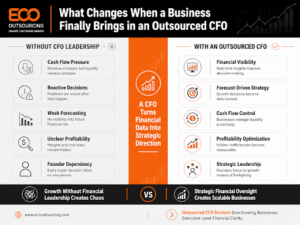
The threshold moments for this transition are usually quite clear. If you are preparing for your first serious investment round or your team has doubled in size over the last year, your financial blind spots are likely growing. Bookkeeping tells you that you have a debt; strategic finance tells you how to use that debt to double your ROI.
Cash Flow Problems Keep Appearing Unexpectedly
It is entirely possible to be profitable on paper and bankrupt in the bank. This is the paradox that kills many SMEs. The timing gaps between income and expenses are the silent killers of scaling companies.
Imagine you have a seasonal business or a company that relies on a few large, slow-paying clients. If your payroll increases faster than your revenue collection, you’re in trouble. Without proper scenario planning the kind that asks “What happens if our biggest client pays 30 days late?”you are living on a knife-edge. Common triggers like unexpected tax obligations or inventory tying up your liquidity can bring a growing company to its knees. Strategic financial planning isn’t just about having cash; it’s about liquidity management and maintaining the reserves necessary to pivot when the market shifts.
You’re Constantly Reacting Instead of Planning
Are you running your business month-to-month, or are you operating toward a three-year financial model? A reactive business solves problems late, often at a premium. A strategic business anticipates those problems and builds the infrastructure to avoid them.
| Reactive Business | Strategic Business |
| Solves problems after they occur | Anticipates problems early |
| Depends on guesswork and “gut” | Uses detailed forecasting |
| Makes emotional, rushed decisions | Makes data-driven decisions |
| Focuses only on survival/maintenance | Plans for sustainable, profitable growth |
| Operates month-to-month | Operates with a multi-year roadmap |
Forecasting and financial modeling are not just academic exercises. They are the blueprints for your growth. If you don’t know what your “break-even” point is for a new product launch, how can you justify the spend? Strategic financial leadership moves you away from emotional decisions and toward a culture of accountability.
Investors, Lenders, or Stakeholders Are Asking Harder Questions
If you’ve ever sat in a meeting with a bank manager or a potential investor and felt your face get hot when they asked about your “burn rate” or “EBITDA margins,” you know the feeling of being under-prepared. These stakeholders want more than just your latest P&L. They want to see that you have a grasp on your financial strategy.
Weak forecasting assumptions and incomplete reports are the fastest ways to kill a deal. Investors aren’t just buying your product; they are buying your ability to manage their capital. If you can’t explain your numbers confidently, you lose credibility instantly. Strategic oversight ensures that your reports are not just accurate, but that they tell a compelling story of a business that is in total control of its destiny.
You Need Strategic Financial Leadership,But Not a Full-Time Executive
One of the biggest hurdles for SMEs is the cost. A top-tier, full-time CFO in a major market can easily command a salary and benefits package north of £150,000. For a company doing £3 million in revenue, that’s a heavy lift.
This is why the fractional model has become so popular. You get access to executive-level expertise, specialist guidance, and the same strategic oversight that a global corporation enjoys, but without the executive salary burden. You pay for the value you need, whether that’s five hours a month or two days a week. It offers the scalability and flexibility that a growing business requires. You get the “heavy hitter” to handle the board meetings and the bank negotiations, while your existing team continues with the day-to-day bookkeeping.
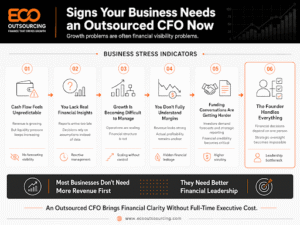
Signs Your Business Is Ready for the Next Financial Stage
How do you know the time is now? Look for these signals:
- Revenue is climbing but your mental clarity is dropping.
- You don’t trust your financial reports to be 100% accurate.
- Cash flow surprises, even small ones happen more than once a quarter.
- You feel like you’re “winging it” when it comes to pricing or expansion.
- Growth feels like a risk you’re taking rather than a plan you’re executing.
- The complexity of your team or product line has moved beyond your personal ability to track it.
FAQ(Frequently Asked Questions)
What are the earliest warning signs that a business needs an outsourced CFO?
The earliest signs include consistently running out of cash despite strong revenue, making major financial decisions based on gut feeling rather than data, and losing visibility over where money is going. When your bookkeeper or general accountant can no longer provide forward-looking financial insight, senior financial leadership is required. Many business owners also find themselves spending more time firefighting financial problems than focusing on growth. Acting on these early warning signs is always cheaper than waiting until the damage is already done.
How do you know when your business has outgrown its current accounting setup?
When your financial reports are always historical rather than forward-looking and cash flow surprises keep catching you off guard, you have outgrown your current setup. A basic bookkeeper records what has already happened, not what happens next. Growing businesses need someone who can build financial models, interpret data, and translate numbers into actionable strategic decisions. If your finances feel reactive rather than proactive, an outsourced CFO is the natural next step.
Is cash flow instability a sign that a business needs an outsourced CFO?
Cash flow instability is one of the most definitive signs that senior financial leadership is urgently needed. Many businesses experience strong revenue on paper but consistently struggle to meet payroll and supplier payments because cash flow is poorly forecasted. An outsourced CFO identifies the root causes whether slow receivables, poor payment terms, or structural cost inefficiencies and implements practical solutions. Addressing cash flow problems at their source is what separates businesses that survive from those that scale.
Should a business consider an outsourced CFO before approaching investors or lenders?
Approaching investors or lenders without robust, professionally prepared financials is one of the most common and costly mistakes growing businesses make. An outsourced CFO ensures your financial statements are accurate, projections are credible, and your business case is structured to give funders the confidence to say yes. They also help you anticipate due diligence questions and prepare clear, data-backed answers that demonstrate financial maturity. Walking into a funding conversation with an outsourced CFO behind your numbers dramatically increases your chances of securing capital.
Can rapid business growth be a sign that you need an outsourced CFO?
Rapid growth is one of the biggest triggers for needing an outsourced CFO because growth without financial control is one of the fastest routes to business failure. As revenue increases, so do the complexities of managing cash flow, tax obligations, payroll, and working capital across a larger operation. Without senior financial oversight, growing businesses frequently find themselves profitable on paper but financially exposed in practice. An outsourced CFO implements the systems and controls needed to ensure your growth is sustainable rather than simply spectacular.
Final Thoughts
The businesses that scale successfully are not always the ones with the flashiest marketing or the most revolutionary products. Usually they are the ones with the strongest financial visibility and strategic control. Revenue is the fuel, but financial strategy is the steering wheel without it you are just going fast in an unknown direction.
Investing in high-level financial support is not about adding a line item to your expenses.it is about buying back your time as a founder and ensuring your growth is sustainable, profitable, and intentional. That is where Eco Outsourcing comes in. From cash flow forecasting and management reporting to funding preparation and tax planning, their experienced team delivers senior financial leadership without the cost of a full-time hire.
With Eco Outsourcing in your corner, you stop wondering “What if?” and start knowing “What’s next.”