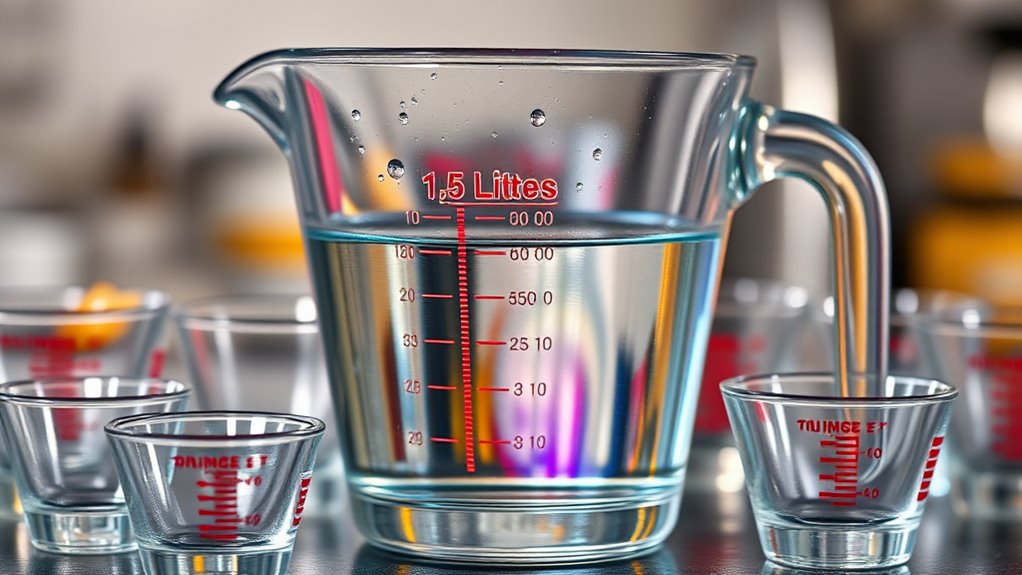
You are standing in the kitchen, recipe in one hand, a metric measuring jug in the other. The recipe wants ounces. Your jug shows liters. And just like that, a simple cooking moment turns into a tiny math crisis.
Or maybe you are at the gym, filling a one-liter water bottle, wondering how many ounces in a liter you just chugged toward your daily goal. The bottle says liters. The fitness app says ounces. So which is it?
This mix-up happens constantly because two different measuring systems are quietly bumping into each other. One side of the world thinks in liters, the other in ounces, and you are caught in the middle.
Here is the good news. The answer is simple, and once you learn it, you will never scramble for it again. There is even one small twist that trips up almost everyone, and knowing it makes you the smartest person in the kitchen.
So how many ounces are in a liter? This guide gives you the clear answer, an easy conversion chart, and the water-bottle math you actually use. By the end, ounces and liters will finally make sense together. Let’s clear it up.
Summary
By the end of this guide, you will know exactly how many ounces are in a liter, with zero confusion.
First, you will get the quick, direct answer, the number you can use right away for cooking, drinking, and daily life.
Next, you will get a simple conversion chart covering common amounts, from half a liter to two liters and beyond.
Then comes the twist almost nobody knows. There is more than one kind of ounce, and mixing them up causes real confusion. You will finally understand the difference.
You will also learn the practical water-bottle math, so you can track your hydration goals with ease.
You will get honest tips on the best tools for converting and measuring accurately.
Finally, you will pick up a simple trick to remember the conversion forever. Read on, and turn liter-to-ounce confusion into confidence for good.
How Many Ounces in a Liter?
Let’s cut straight to what you came for. Here is the clear, simple answer.
There are about 33.8 fluid ounces in one liter. More precisely, one liter equals roughly 33.814 fluid ounces, but 33.8 is close enough for everyday cooking, drinking, and measuring.
To keep it easy to remember, you can round to about 34 fluid ounces per liter. That mental shortcut works perfectly for most real-life situations, like filling a water bottle or following a recipe.
This uses the standard fluid ounce common in most home kitchens here. So when a bottle says one liter, you now know it holds nearly 34 fluid ounces of liquid.
Simple, right? But liters connect to many other amounts you use daily, like half-liters and two-liter bottles. So let’s look at the full picture with a handy chart.
The Simple Conversion Chart
Here is where it all clicks into place. Most of the amounts you deal with are just multiples of that one number. Let’s map them out.
Since one liter is about 33.8 fluid ounces, everything else follows easily. Half a liter is about 16.9 fluid ounces. Two liters is about 67.6 fluid ounces. And three liters is roughly 101.4 fluid ounces.
Here is a quick reference to keep handy:
- 0.5 liter = about 16.9 fluid ounces
- 1 liter = about 33.8 fluid ounces
- 1.5 liters = about 50.7 fluid ounces
- 2 liters = about 67.6 fluid ounces
- 3 liters = about 101.4 fluid ounces
Notice the pattern. Every value is just the number of liters multiplied by 33.8. Once you know that, you can convert any amount in seconds. But before you trust that number everywhere, there is a twist you need to know about.
The Twist: Not All Ounces Are Equal
Here is the detail that confuses almost everyone, and few guides explain it. The word “ounce” does not always mean the same thing. There are actually two different fluid ounces in the world.
The first is the fluid ounce common in most kitchens here, and it makes one liter equal about 33.8 of them. The second is the imperial fluid ounce, used in some other places, which is a slightly different size. By that measure, one liter equals about 35.2 fluid ounces.
So depending on which system a recipe or website uses, you might see 33.8 or 35.2 for the same liter. Neither is wrong. They are just two different standards, which is why online answers sometimes seem to disagree.
Here is my honest, practical opinion. Do not overthink this. For nearly everything you do at home, use 33.8 fluid ounces per liter, and you will be perfectly fine. Only reach for the imperial number if a recipe clearly comes from a place that uses it. Now, let’s use this for the thing people ask about most: water.
Water Bottle and Hydration Math
This is where the conversion becomes truly useful in daily life. Tracking your water intake gets easy once you connect liters to ounces.
A standard single-use plastic water bottle usually holds about 16.9 fluid ounces, which is half a liter. So two of those bottles make roughly one liter, or about 33.8 fluid ounces. That is a handy anchor to remember.
Say your goal is to drink two liters of water a day, a common target. That equals about 67.6 fluid ounces, or roughly four standard half-liter bottles. Suddenly your daily goal becomes easy to picture and track.
Want three liters? That is about 101 fluid ounces, or around six standard bottles. Framing it in bottles makes a big hydration goal feel far more manageable. This simple math turns a vague target into a clear, countable plan you can actually follow through your day.
Handy Tools for Converting and Measuring
Knowing the number is great, but the right tools make conversions and measuring effortless. Here are your best options, with honest pros and cons.
A conversion app or online calculator. Type in any amount for an instant answer. Pros: fast, free, and handles any number precisely. Cons: you need your phone handy, though for a quick check it is unbeatable.
A dual-marked measuring cup. Many measuring cups show both ounces and liters or milliliters. Pros: you can measure and convert at a glance, no math needed. Cons: markings can be small or hard to read on cheaper cups.
A kitchen scale with liquid settings. Some scales measure liquid volume. Pros: very accurate and great for precise recipes. Cons: it costs more and is overkill for casual cooking.
A simple printed chart. An old-school conversion chart on your fridge. Pros: no device needed, always visible, and foolproof. Cons: it only covers the amounts listed. Honestly, for most people a fridge chart plus the number 33.8 covers nearly everything.
Easy Tricks to Remember It
Let’s lock this in so you never have to search again. A couple of simple tricks make the conversion stick for life.
The easiest is to just remember “about 34.” One liter is close to 34 fluid ounces. That single rounded number handles most everyday needs, from filling bottles to cooking, without any fuss. Round numbers are easy to recall under pressure.
Another handy anchor is the water bottle trick. A common small water bottle is about 17 ounces, and two of them make roughly a liter. If you can picture two bottles, you can picture a liter. That mental image is surprisingly powerful.
For anything needing real precision, like a careful recipe, use the exact 33.814 or a quick calculator. But for daily life, “about 34” is your friend. Looking ahead, more products now label both liters and ounces together, and smart kitchen tools convert automatically, so this math is only getting easier. Still, knowing the number keeps you quick and confident.
You can also read about How to Drive a Manual Car.
Conclusion
That kitchen math crisis is officially solved. You now know a liter holds about 33.8 fluid ounces, and you understand how liters and ounces connect.
Remember the key points. One liter is about 33.8 fluid ounces, which you can round to 34 for daily use. Half a liter is about 16.9 ounces, and two liters is about 67.6. And watch for the imperial ounce, which makes a liter about 35.2, though you will rarely need it.
Above all, remember the simplest takeaway. For cooking, hydration, and everyday life, just think “a liter is about 34 ounces,” and you will always be close enough.
Here is your one clear next step. Write “1 liter = about 33.8 oz” on a sticky note and pop it on your fridge or water bottle. The next time liters and ounces collide, you will smile instead of scrambling for your phone.
So tell me, are you converting for a recipe in the kitchen, or tracking how much water you are drinking toward your daily goal?