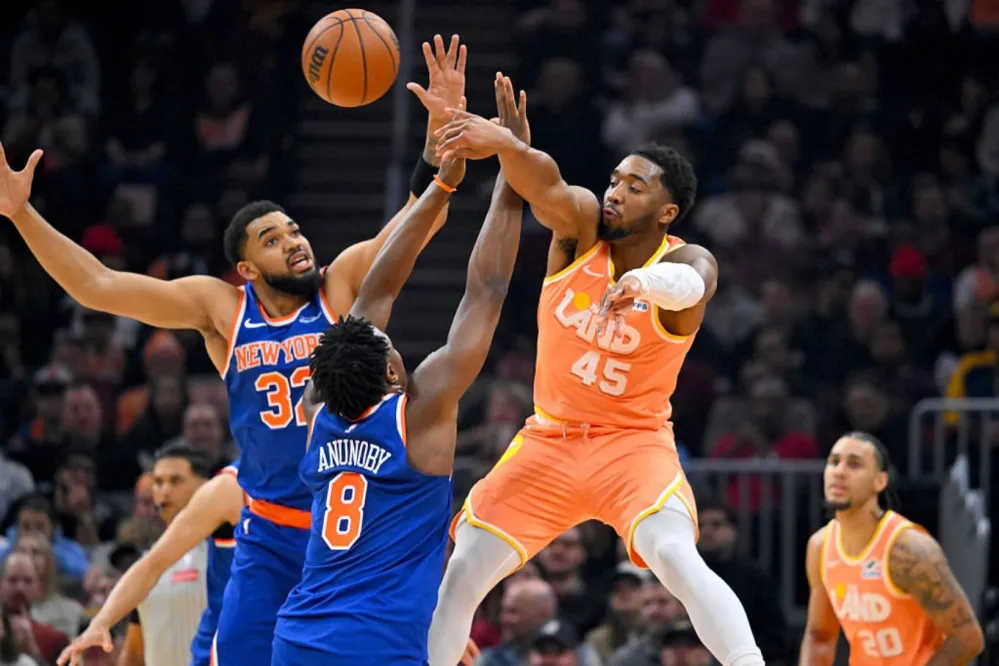
The latest chapter of the Cleveland Cavaliers and New York Knicks rivalry feels bigger than a normal playoff series. Between the star power of Jalen Brunson and Donovan Mitchell, the physical battle in the paint, and the pressure of the Eastern Conference Finals spotlight, this matchup has become one of the most compelling postseason stories in the NBA.
The Knicks enter the series with momentum, confidence, and one of the loudest home-court advantages in basketball at Madison Square Garden. Cleveland counters with elite defensive length, frontcourt size, and the shot creation of Mitchell. Betting markets have treated the matchup as highly competitive, with sportsbooks shifting lines quickly based on injury reports, public money, and playoff performance trends.
For fans, bettors, and analysts, the real intrigue comes from the tactical details. Can Cleveland’s defensive identity slow Brunson’s half-court control? Will the Knicks dominate the offensive glass? Can Donovan Mitchell consistently pressure New York’s perimeter defense? Those questions will likely determine who reaches the NBA Finals.
This complete breakdown examines the odds, predictions, tactical matchups, coaching adjustments, statistical trends, and roster factors shaping the Cavaliers vs Knicks showdown.
The Eastern Conference Rivalry Reimagined: Setting the Stage
The Cavaliers and Knicks have developed one of the Eastern Conference’s most physical and emotionally charged rivalries. What once looked like a traditional playoff matchup has evolved into a strategic battle between two organizations built very differently.
New York relies on physicality, rebounding, wing versatility, and Brunson’s leadership. Cleveland counters with size, defensive mobility, and shot creation around Donovan Mitchell.
The Road to the Eastern Conference Finals: Stakes and Momentum
Momentum matters in the NBA playoffs, and both teams arrived at this series through dramatically different paths.
The Knicks entered the Eastern Conference Finals after playing some of their best basketball of the season. Their playoff run featured elite perimeter defense, improved offensive spacing, and consistent late-game execution. Madison Square Garden became one of the league’s toughest environments, particularly during clutch moments.
Cleveland’s journey was more exhausting. The Cavaliers survived multiple physical playoff battles before advancing, which raised concerns about fatigue, bench usage, and late-series conditioning. Despite those concerns, Cleveland still entered the matchup with one of the NBA’s most effective defensive ratings.
The stakes are enormous:
| Team | Primary Strength | Biggest Concern |
|---|---|---|
| Cleveland Cavaliers | Interior defense and rim protection | Late-game offensive stagnation |
| New York Knicks | Physicality and rebounding | Managing minutes and health |
The winner earns a trip to the NBA Finals, but this series also carries long-term significance. Both organizations invested heavily in star-driven rosters designed specifically for deep postseason success.
Recent History: Lessons from Past Playoff Series
Recent Cavaliers vs Knicks playoff history still influences how analysts evaluate this matchup.
Previous postseason meetings highlighted several recurring themes:
- New York consistently controlled offensive rebounds.
- Cleveland struggled with half-court spacing under pressure.
- Jalen Brunson repeatedly exploited defensive switches.
- Physical play dramatically impacted pace and efficiency.
The Knicks learned they could pressure Cleveland’s guards physically and force difficult half-court possessions. Cleveland learned that defensive rebounding and perimeter shot creation become critical against Tom Thibodeau’s playoff-style basketball.
The current versions of these teams are deeper and more talented, but many tactical patterns remain the same.
you can also read about davante adams takes a swipe at the bears.
Betting Intelligence: Odds, Spreads, and Market Trends
Sports betting markets reacted aggressively to this series because both teams entered with legitimate championship expectations. Early line movement reflected public confidence in New York’s momentum while advanced metrics still respected Cleveland’s defensive ceiling.
Understanding the odds requires more than looking at favorites and underdogs.
Current Lines: Analysis of the Spread and Over/Under via DraftKings and FanDuel
Early sportsbook numbers showed New York opening as a moderate favorite at Madison Square Garden.
According to DraftKings opening odds analysis, the Knicks initially received stronger support because of rest advantages, recent form, and home-court momentum. FanDuel projections similarly reflected respect for New York’s offensive efficiency and playoff consistency.
Typical market ranges included:
| Betting Market | Typical Range |
|---|---|
| Knicks spread | -4.5 to -7.5 |
| Total points | 221.5 to 232.5 |
| Cavaliers moneyline | +140 to +200 |
| Knicks series price | Slight favorite |
Totals fluctuated heavily depending on injury news and expected pace.
Sharp bettors often leaned toward the under because playoff basketball tends to slow down, particularly in half-court possessions. However, both teams also possess strong three-point shooting stretches capable of changing totals quickly.
Several factors influenced market movement:
- Cleveland’s fatigue after lengthy playoff rounds.
- New York’s rest advantage.
- Brunson’s clutch scoring consistency.
- Injury management for both teams.
- Public confidence in Madison Square Garden home games.
SportsLine Projection Model: Data-Driven Win Probabilities
Projection systems generally viewed the series as close despite New York’s public momentum.
Data-driven playoff models typically weigh:
- Net rating
- Effective field goal percentage
- Turnover margin
- Rebounding percentage
- Defensive efficiency
- Clutch performance
Cleveland ranked extremely well in defensive metrics throughout the season, particularly in rim protection and opponent field-goal percentage inside the paint.
New York’s statistical edge came from physical play, offensive rebounding, and wing defense.
Most projection systems viewed the series as likely extending to six or seven games because both teams can win in multiple styles.
Sharp Money vs. Public Betting: Where the Value Lies in the Series Price
One of the most interesting betting storylines involved disagreement between public bettors and professional bettors.
Public money leaned heavily toward the Knicks because:
- Madison Square Garden carries emotional betting appeal.
- Brunson became one of the postseason’s most trusted clutch performers.
- New York entered the series on a strong winning streak.
Sharp bettors often looked toward Cleveland value because elite defensive teams historically remain dangerous in long playoff series.
Key betting trends included:
| Trend | Impact |
|---|---|
| Knicks strong at home | Increased spread support |
| Cavs elite defensive rating | Under betting support |
| Brunson playoff scoring | Player prop movement |
| Cleveland rebounding inconsistency | Knicks series support |
The best value frequently depended on pace expectations. Faster games generally favored New York’s transition opportunities, while slower half-court games increased Cleveland’s defensive impact.
The Star Power Showdown: Jalen Brunson vs. Donovan Mitchell
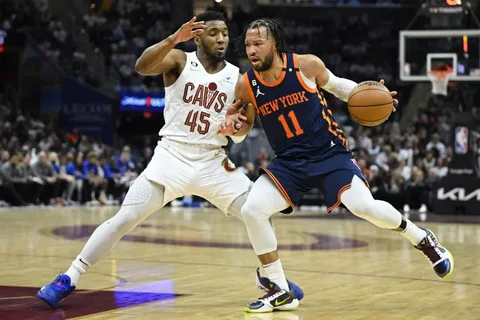
Every playoff series eventually becomes about stars creating advantages under pressure. In Cavaliers vs Knicks, that conversation starts with Jalen Brunson and Donovan Mitchell.
Both guards operate differently, but each controls the emotional and tactical identity of his team.
Analyzing the Brunson Era: Managing the Knicks’ Offensive Possessions
Jalen Brunson transformed the Knicks into one of the NBA’s most organized half-court offenses.
His greatest strength is control.
Brunson rarely rushes possessions, consistently manipulates defenders in pick-and-roll situations, and creates efficient mid-range scoring opportunities. His footwork and patience force defenders into difficult decisions.
Against Cleveland, Brunson’s responsibilities include:
- Attacking switches.
- Pulling Jarrett Allen and Evan Mobley away from ideal rim positions.
- Creating corner three opportunities.
- Managing late-clock possessions.
- Limiting turnovers.
One of the defining playoff trends has been Brunson’s ability to elevate his scoring in clutch moments. When games slow down late, his pace control becomes even more valuable.
Important Brunson playoff traits:
| Skill Area | Impact on Series |
|---|---|
| Mid-range efficiency | Punishes drop coverage |
| Pick-and-roll control | Creates spacing advantages |
| Clutch scoring | Stabilizes late offense |
| Ball security | Reduces transition opportunities |
The Knicks depend heavily on Brunson’s ability to dictate tempo.
Mitchell’s Return to the Garden: Scoring Volume and Playmaking Pressure
Donovan Mitchell approaches the game differently.
Where Brunson controls pace, Mitchell attacks explosively.
Mitchell’s downhill scoring pressure forces defenses to collapse, opening perimeter opportunities for Cleveland shooters. His ability to create offense quickly can swing playoff momentum in minutes.
Against New York, Mitchell faces multiple defensive challenges:
- OG Anunoby’s physical perimeter defense.
- Mikal Bridges’ length.
- Aggressive help defense.
- Crowd pressure at Madison Square Garden.
Still, Mitchell remains one of the NBA’s most dangerous postseason scorers.
Key areas to watch:
- Three-point shot volume.
- Free throw attempts.
- Late-game shot selection.
- Turnover management.
- Transition scoring opportunities.
When Mitchell consistently attacks early in possessions, Cleveland’s offense becomes significantly harder to defend.
The Pick-and-Roll Chess Match: Exploiting Defensive Ratings
Modern playoff basketball revolves around pick-and-roll efficiency.
This series presents fascinating tactical questions because both teams defend the action differently.
Cleveland typically prefers size-based defensive schemes featuring:
- Drop coverage.
- Rim protection.
- Weak-side shot contests.
- Rotational help defense.
New York uses more aggressive perimeter pressure and physical switching.
The battle often comes down to whether Brunson or Mitchell can force favorable mismatches.
Important tactical adjustments include:
| Situation | Team Advantage |
|---|---|
| Brunson attacking drop coverage | Knicks |
| Mitchell in transition | Cavaliers |
| Switching against wings | Knicks |
| Rim protection scenarios | Cavaliers |
Whichever team better manipulates pick-and-roll spacing could ultimately control the series.
Battle of the Frontcourts: Size, Rebounding, and Rim Protection
The frontcourt battle may decide the series more than guard scoring.
Both teams feature elite size, rebounding, and interior defensive talent.
Cleveland’s Defensive Identity: The Impact of Evan Mobley and Jarrett Allen
Cleveland built its defensive system around Evan Mobley and Jarrett Allen.
Mobley’s versatility allows the Cavaliers to defend multiple offensive styles. He can switch onto wings, recover as a help defender, and protect the rim without sacrificing mobility.
Allen provides traditional interior strength:
- Rebounding.
- Rim protection.
- Screen setting.
- Efficient finishing.
Together, they create one of the NBA’s best defensive frontcourts.
Key Cleveland frontcourt advantages:
| Player | Core Strength |
|---|---|
| Evan Mobley | Defensive versatility |
| Jarrett Allen | Interior physicality |
Their biggest challenge involves spacing.
When New York spreads the floor with shooting, Cleveland’s bigs must defend farther from the basket, reducing some of their rim protection value.
The Knicks’ New Look: Karl-Anthony Towns and the Mitchell Robinson Factor
The Knicks added offensive versatility with Karl-Anthony Towns.
Towns changes defensive geometry because opposing centers cannot simply camp near the rim. His shooting range forces difficult matchup decisions.
Mitchell Robinson adds a completely different element:
- Offensive rebounding.
- Interior physicality.
- Shot blocking.
- Second-chance opportunities.
The Knicks often use Robinson specifically to create extra possessions and wear down opposing frontcourts.
Potential Knicks concerns include:
- Robinson free-throw struggles.
- Foul trouble.
- Towns defending physical interior possessions.
Still, New York’s frontcourt depth gives Tom Thibodeau multiple tactical combinations.
Second-Chance Points: The Critical Importance of Rebounding Percentage
Rebounding may become the series’ single most important statistical category.
The Knicks consistently generate extra possessions through offensive rebounds. That style becomes especially valuable in playoff basketball when half-court scoring efficiency declines.
Second-chance points influence:
- Momentum.
- Crowd energy.
- Transition defense.
- Foul pressure.
- Pace control.
Key rebounding factors:
| Rebounding Category | Why It Matters |
|---|---|
| Offensive rebounds | Creates extra possessions |
| Defensive rebounds | Prevents momentum swings |
| Long rebounds | Generates transition offense |
If Cleveland loses the rebounding battle consistently, its defensive advantages become harder to maintain.
Tactical Deep Dive: The Coaching Chess Match
Playoff basketball often becomes a coaching series as much as a player series.
Kenny Atkinson and Tom Thibodeau bring dramatically different philosophies, but both coaches excel in preparation and defensive organization.
Kenny Atkinson’s Defensive Schemes: Neutralizing the Knicks’ Perimeter Threats
Kenny Atkinson emphasizes defensive discipline and rotational awareness.
Against New York, his defensive priorities likely include:
- Limiting Brunson’s driving angles.
- Contesting corner threes.
- Protecting the paint.
- Reducing transition opportunities.
Cleveland’s perimeter defense depends heavily on communication.
The Cavaliers cannot allow Brunson to dictate comfortable half-court possessions. Expect aggressive screen navigation and selective trapping during critical stretches.
Atkinson also faces rotation challenges.
Managing minutes for Mobley and Allen without sacrificing spacing remains difficult against New York’s physical lineup combinations.
Tom Thibodeau’s Rotation Discipline: Managing High-Minute Starters
Tom Thibodeau has long trusted his starters heavily.
In the playoffs, that philosophy becomes both a strength and a concern.
Advantages of Thibodeau’s approach:
- Better defensive continuity.
- Improved late-game chemistry.
- Consistent matchup management.
Potential drawbacks:
- Fatigue.
- Injury risk.
- Reduced bench flexibility.
The Knicks thrive on physical consistency. Thibodeau wants predictable defensive intensity throughout the game.
Managing Brunson’s workload becomes especially important during long playoff series.
Identifying the Mismatch: How OG Anunoby and Mikal Bridges Alter the Geometry
OG Anunoby and Mikal Bridges fundamentally change New York’s defensive ceiling.
Both wings provide:
- Length.
- Defensive versatility.
- Perimeter disruption.
- Secondary scoring.
Their presence allows New York to switch more aggressively without losing defensive structure.
The strategic impact is enormous.
Instead of sending constant help defense toward Mitchell, the Knicks can trust individual defenders more often. That reduces open three-point opportunities for Cleveland shooters.
The Knicks also use Bridges and Anunoby to improve offensive spacing. Their corner shooting forces defenders to stay attached, creating better driving lanes for Brunson.
The Injury Factor and Roster Depth
Injuries shape every playoff series.
Depth, recovery management, and availability often matter as much as talent.
Navigating the Training Room: Impact of Hamstring Strains and Lingering Injuries
Playoff basketball places enormous stress on players physically.
Minor injuries that seem manageable during the regular season become major concerns in deep playoff runs.
Important injury-related issues include:
| Injury Type | Potential Impact |
|---|---|
| Hamstring strains | Reduced explosiveness |
| Ankle soreness | Limited lateral movement |
| Knee inflammation | Minute restrictions |
| Back tightness | Shooting inconsistency |
Even slight mobility limitations can dramatically affect perimeter defenders against elite guards.
Monitoring daily injury reports becomes critical for bettors and analysts because line movement often reacts immediately to availability news.
Bench X-Factors: The Perimeter Threat of Sam Merrill and Dean Wade
Championship-level playoff series frequently feature unexpected role-player performances.
For Cleveland, Sam Merrill and Dean Wade represent important spacing pieces.
Merrill provides:
- Perimeter shooting.
- Floor spacing.
- Quick release shooting.
Dean Wade contributes:
- Defensive versatility.
- Rebounding support.
- Rotational stability.
Bench production becomes particularly important when stars face aggressive defensive pressure.
New York’s bench contributions also matter, especially in physical games where foul trouble affects rotations.
Turnover Management: How Bench Depth Stabilizes Late-Game Execution
Late playoff games often become turnover battles.
Bench depth matters because exhausted starters make more mistakes under pressure.
Critical late-game areas include:
- Entry passes.
- Transition defense.
- Ball handling under traps.
- Shot-clock management.
- Defensive communication.
Teams with deeper rotations frequently maintain better execution in fourth quarters.
That could become increasingly important if the series reaches six or seven games.
Key Statistical Indicators for Success
Statistics never tell the full playoff story, but certain metrics consistently predict postseason success.
For Cavaliers vs Knicks, several indicators stand out.
Beyond the Arc: 3-Pointer Consistency and Effective Field Goal Percentage
Modern playoff basketball depends heavily on perimeter efficiency.
Effective field goal percentage becomes especially important because it properly values three-point shooting.
Important shooting categories include:
| Statistical Area | Why It Matters |
|---|---|
| Corner three percentage | Punishes defensive help |
| Catch-and-shoot efficiency | Creates spacing |
| Effective field goal percentage | Measures scoring efficiency |
| Transition threes | Generates momentum |
The Knicks improved dramatically as a shooting team after adding more wing spacing.
Cleveland depends heavily on perimeter balance around Mitchell.
If either team experiences extended cold shooting stretches, games could swing quickly.
Defensive Discipline: Free Throw Rate and Avoiding Foul Trouble
Free throws quietly decide playoff games.
Teams that defend without fouling gain major advantages in physical postseason environments.
Key foul-related concerns:
- Brunson’s ability to draw contact.
- Mitchell attacking downhill.
- Robinson’s physical rebounding.
- Towns defending in space.
Foul trouble creates cascading problems:
- Rotation disruptions.
- Defensive hesitation.
- Reduced rebounding aggression.
- Easier scoring opportunities.
Disciplined defense often matters more than highlight plays during playoff basketball.
Clutch Time Performance: Efficiency in the Final Five Minutes
Close playoff games eventually become clutch-time battles.
The final five minutes typically slow into half-court possessions, matchup hunting, and isolation scoring.
Key clutch factors include:
| Clutch Area | Advantage |
|---|---|
| Isolation scoring | Brunson |
| Explosive shot creation | Mitchell |
| Offensive rebounding | Knicks |
| Rim protection | Cavaliers |
The Knicks have looked calmer in late-game situations throughout the postseason.
However, Cleveland’s defensive ceiling keeps them dangerous in every close game.
Final Predictions and Expert Verdict
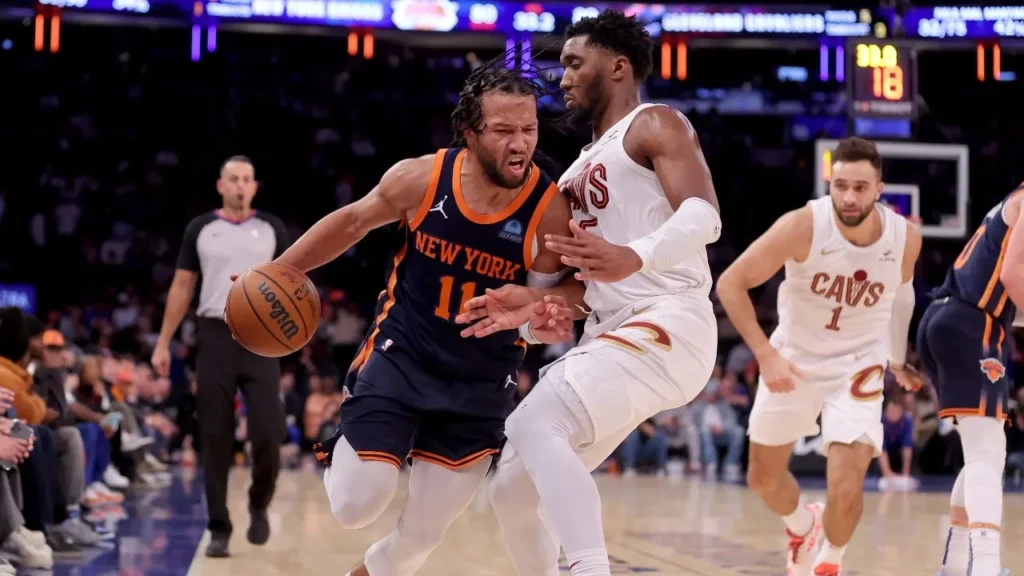
This series combines elite guard play, physical frontcourt battles, tactical adjustments, and intense playoff pressure.
The margin between these teams is extremely small.
Game-by-Game Outlook: Why Home Court Advantage at Madison Square Garden Matters
Madison Square Garden changes playoff basketball.
The environment affects:
- Opposing communication.
- Offensive rhythm.
- Momentum swings.
- Officiating pressure.
- Emotional intensity.
New York’s confidence at home has become one of its greatest advantages.
The Knicks feed off energy runs, especially during defensive stretches and offensive rebounding possessions.
Potential series flow:
| Game Scenario | Likely Advantage |
|---|---|
| Fast-paced home games | Knicks |
| Slower defensive battles | Cavaliers |
| High-scoring fourth quarters | Knicks |
| Half-court defensive games | Cavaliers |
Cleveland still possesses enough talent to steal road wins, particularly if Mitchell dominates offensively.
Predicted Series Outcome: Can the Cavs Overcome the Knicks’ Physicality?
The Cavaliers absolutely have the talent to win the series.
Mobley and Allen create enormous defensive pressure, while Mitchell remains capable of producing explosive scoring performances.
Still, New York appears slightly better positioned overall.
Reasons the Knicks hold the edge:
- Better playoff momentum.
- Superior wing depth.
- Elite rebounding pressure.
- Brunson’s late-game composure.
- Madison Square Garden advantage.
Predicted outcome:
Knicks win series in seven games.
The expectation is a highly physical, emotionally intense series with multiple close finishes.
The Strategic Pivot: One Adjustment That Will Decide the Series
One tactical adjustment could decide everything:
Can Cleveland consistently limit New York’s offensive rebounds without sacrificing perimeter defense?
That balance is incredibly difficult.
If Cleveland commits too many defenders toward rebounding, Brunson and the Knicks’ shooters gain spacing advantages.
If the Cavaliers prioritize perimeter defense, New York’s second-chance opportunities increase.
That strategic tension sits at the center of the entire series.
Game Essentials: How to Watch and Attend
Fans following Cavaliers vs Knicks have multiple viewing and listening options throughout the Eastern Conference Finals.
Madison Square Garden also remains one of the NBA’s most popular playoff destinations.
Broadcast Schedule: ESPN Networks, SiriusXM, and Local Radio (WTAM/WMMS)
National coverage typically includes:
| Platform | Coverage Type |
|---|---|
| ESPN | National television broadcasts |
| ABC | Select marquee playoff games |
| SiriusXM | National radio coverage |
| WTAM/WMMS | Cleveland local radio |
| MSG Network | Regional Knicks analysis |
Broadcast schedules may vary depending on game dates and television assignments.
Live Coverage and Real-Time Analysis: Inside The NBA and Watch ESPN
Fans seeking deeper analysis can follow:
- Watch ESPN live streams.
- Inside The NBA postgame coverage.
- Real-time statistics apps.
- Team-specific radio coverage.
Pregame analysis often focuses heavily on injury updates, lineup changes, and betting movement.
Venue Logistics: SpotHero Parking, Chase Entrances, and Madison Square Garden FAQs
Fans attending games at Madison Square Garden should plan ahead because playoff crowds create major traffic and security delays.
Important logistics include:
| Venue Topic | Key Information |
|---|---|
| Parking | SpotHero reservations recommended |
| Entry | Chase entrances may reduce wait times |
| Arrival | Early arrival strongly advised |
| Security | Standard NBA playoff security checks |
Madison Square Garden playoff games typically create extremely high demand for parking, nearby hotels, and public transportation.
Frequently Asked Questions
Who is favored in Cavaliers vs Knicks playoff games?
The Knicks have generally entered recent playoff matchups as slight favorites because of home-court advantage, playoff momentum, and strong late-game performance.
What is the biggest matchup in Cavaliers vs Knicks?
The most important matchup is Jalen Brunson versus Donovan Mitchell. Their scoring, decision-making, and clutch execution heavily influence the series outcome.
Why is rebounding so important in Cavaliers vs Knicks?
New York relies heavily on offensive rebounds and second-chance points. Cleveland must control defensive rebounds to avoid giving the Knicks extra possessions.
How do the Cavaliers defend the Knicks?
Cleveland uses size, rim protection, and disciplined help defense anchored by Evan Mobley and Jarrett Allen.
Why does Madison Square Garden matter so much?
Madison Square Garden provides one of the NBA’s strongest playoff environments. Crowd energy can dramatically influence momentum and late-game pressure.
What betting trends matter most in Cavaliers vs Knicks?
Key trends include home-court performance, rebounding percentage, clutch scoring efficiency, injury updates, and total points movement.
Final Takeaway
Cavaliers vs Knicks represents everything great about playoff basketball.
The series combines elite guards, physical rebounding battles, tactical coaching adjustments, defensive intensity, and one of the league’s most electric playoff environments.
The Knicks appear slightly better positioned because of wing depth, rebounding pressure, and Brunson’s control in clutch situations. Cleveland still possesses enough defensive talent and star scoring to push the matchup to the limit.
For fans, bettors, and analysts, the smartest approach is focusing on the small details:
- Rebounding percentage.
- Turnover margin.
- Pick-and-roll execution.
- Injury management.
- Fourth-quarter shot creation.
Those factors often decide playoff basketball far more than headline narratives.
As the series unfolds, expect momentum swings, physical games, and tactical adjustments that continue redefining one of the Eastern Conference’s most fascinating rivalries.
Sources referenced for statistical context and playoff trends include NBA game data, ESPN coverage, DraftKings analysis, FanDuel betting markets, Reuters reporting, and playoff matchup reports from May 2026.